Guide · 04/11/2026 · 8 min read
Storing Gold Coins: Home Safe or Bank Vault?

When buying gold coins, most of the thinking goes into which coin or bar to pick. The storage question only comes up once the purchase is in hand and you have to decide where it actually goes. It belongs to the same decision, though: how you store determines how quickly you can reach your gold, what it costs you every year, and what happens on the worst possible day.
Below we compare three practical options — a home safe, a bank safe deposit box, and a professional vault — and look at what to check in each case. You can always find the current gold price on our price page; the logic of storage itself does not depend on the price.
Gold Packs Extraordinary Value Into Very Little Space
What makes gold storage distinctive starts with physics. One troy ounce is 31.1 grams, and on 3 November 2026 the gold spot price was roughly 3,900 dollars per ounce according to Kitco. That means ten one-ounce coins — about 311 grams in total, enough to cup in two hands — carry close to 39,000 dollars in value.
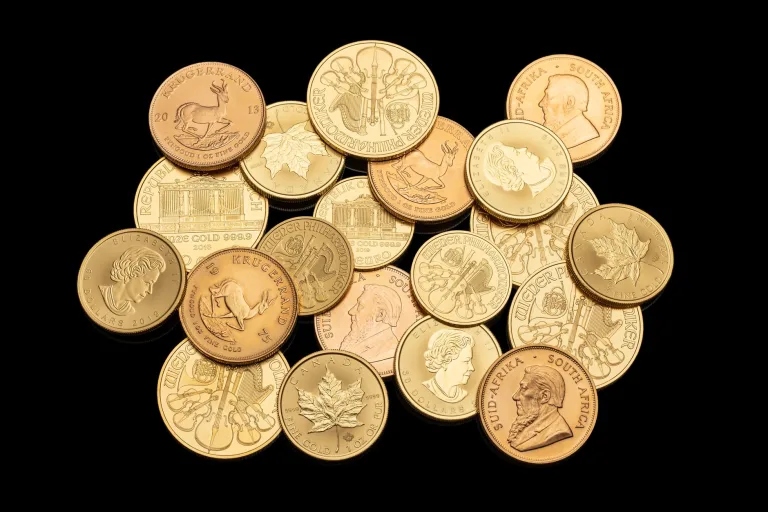
In practice that is both an advantage and a risk. An advantage, because a portfolio of serious size needs only a small lockable volume: a stack of Philharmonic gold coins, for instance, takes up less shelf space than a single book. A risk, because the same compactness makes gold an ideal target for theft — it fits in a pocket, and a thief does not have to dispose of it piece by piece.
With silver it is the other way round. Because the silver price per ounce is many times lower than gold’s, storing the same monetary value in silver takes considerably more space and weight. A one-kilogram Valcambi silver bar is a solidly heavy object in the hand, and a multi-kilo silver position turns the choice of a home safe into a question of volume, not just security.
Keeping It at Home: Full Control, and What That Costs
The big advantage of home storage is access. You do not depend on opening hours, contracts or a third party, and you can get to your gold at any hour. The responsibility is equally and entirely yours.
The risk of theft in Estonia is not theoretical. According to the crime overview published by the Estonian Ministry of Justice and Digital Affairs, 10,690 thefts were recorded in 2025 — 6% more than the year before, and the highest figure since 2015. Of those, 5,340 were thefts from dwellings. Property crimes totalled 15,092 and made up 54% of all recorded crimes, up from 52% in 2024.
If you decide on a home solution, a few practical things matter more than the rest:
- A certified safe, not just a metal box. Safes carry resistance grades, usually referenced in Europe under the EN 1143-1 standard. A cheap office safe mainly protects against curiosity and fire, not against a deliberate break-in.
- Bolt it to the structure. An unanchored safe is a portable safe. A box weighing a little over a hundred kilos moves surprisingly easily with two people and a hand trolley.
- A location that isn’t the first place anyone looks. The bedroom wardrobe and the home-office desk are obvious. A safe needs to be both concealed and anchored — not one or the other.
- Discretion. Most of the information that makes a theft possible travels through conversation — at work, on social media, in front of contractors. If nobody knows there is gold in the house, the house is not a target.
A Bank Safe Deposit Box: What the Contract Actually Covers
A bank safe deposit box offers physical security you cannot expect from a home setup: a guarded building, controlled access, fire protection. This is also where the most common misunderstanding arises, and it is worth clearing up before you sign.
The deposit guarantee scheme, which protects money in a bank account up to 100,000 euros per depositor per credit institution (Bank of Estonia), is a guarantee on money. It is not a guarantee on the contents of a safe deposit box — physical gold is not a deposit. For box contents, liability is set solely by the rental agreement. So ask three things before signing: what the bank’s liability cap for the contents is, whether and how the contents must be declared, and what happens to the agreement in a bankruptcy or merger.
The second practical limitation is access. You can reach the box during branch opening hours, not at two in the morning on a weekend. For most investors that is no problem, but it does sit awkwardly with one common reason for buying gold in the first place — the wish to hold an asset that is always within reach.
A Professional Vault: Allocated or Pooled
The third option is a vault specialising in precious metals. Here a single distinction matters, and you should ask about it directly: is the storage allocated (your specific coins and bars, with serial numbers, in your name) or pooled (you hold a claim on a quantity of metal within a general stock)?
Allocated storage costs more, but you get back exactly the items you handed over. Pooled storage is cheaper and introduces counterparty risk: your position is only as strong as the custodian’s bookkeeping and solvency. If the description of a service does not state plainly which one it is, that in itself is an answer. Also ask how often an independent audit is carried out, who the actual custodian is, and what the withdrawal terms and fees are.
Insurance: The Most Common Mistake
The typical assumption is that gold kept at home is covered by home insurance. In reality, home insurance policies almost always set a separate indemnity limit for valuables, cash and precious metals, well below the overall contents limit. Without an additional agreement, a payout may cover only a small fraction of the real value.
What to do: read the valuables clause in your policy, ask your insurer directly about the limit for precious metals and about separate additional cover if needed, and find out what safe or security requirement that cover assumes. The insurer may require a specific resistance grade — in which case the insurance determines your choice of safe, not the other way round.
Every option shares one precondition: documentation. Keep purchase invoices, certificates and original packaging separately from the gold itself, along with photographs and serial numbers. Gold bars normally come on a sealed card carrying a serial number — that card is part of the item’s value and part of the evidence in an insurance claim. Without the paperwork, both a claim and a later sale become more awkward.
Splitting the Position: A Sensible Middle Road
In practice many investors do not pick one option but divide the position. The smaller part — the portion they want quick access to — stays in an anchored home safe, while the bulk goes to a safe deposit box or a vault. Splitting reduces two risks at once: the total loss of a single location, and the situation where every ounce you own happens to be out of reach.
If the quantity is small, an anchored safe and proper insurance are usually enough, and there is little point paying vault fees. If the position is larger than an amount whose loss would genuinely hurt, external storage starts to justify itself. Where exactly that line falls depends on your circumstances, where you live, and the terms of your insurance.
A Checklist Before You Decide
- How fast do you realistically need access — hours, days or weeks?
- What is the valuables limit in your home insurance, and what does additional cover require?
- If you choose a safe deposit box: what is the bank’s liability cap for the contents?
- If you choose a vault: allocated or pooled, and who audits it?
- What does the solution cost per year as a percentage of the position’s value?
- Who else knows where your gold is, and can anyone reach it if they need to?
Frequently Asked Questions
Is keeping gold at home legal in Estonia?
Yes. Buying physical investment gold and keeping it at home is legal, and there is no storage limit on the quantity. The question is one of security and insurance, not permission.
Does the bank know what is in my safe deposit box?
That depends on the contract. Some banks require the contents to be declared and others do not — and declaring is usually tied to the liability cap. Check this for the specific agreement rather than assuming.
Can I take the gold out of its original packaging?
Physically yes, but there is no good reason to. Sealed packaging and a certificate make a later sale and an insurance claim simpler. Coins and bars are best kept in their original packaging, and the surfaces are best not handled with bare hands.
Should the safe be fireproof?
Gold itself only melts above 1,000 °C, so a fire is unlikely to destroy the metal. Certificates, invoices and packaging will burn, however — precisely the part that proves authenticity and ownership. Fire protection is therefore more about the documents than the metal.
This article is for informational purposes only and does not constitute investment advice or a solicitation to buy or sell precious metals. Precious metal prices fluctuate. Before making any investment decision, consider your own circumstances and consult a specialist if necessary.
Goldman & Sons editorial team