Guide · 19/08/2026 · 7 min read
Silver VAT in Estonia: why silver isn’t tax-free like gold
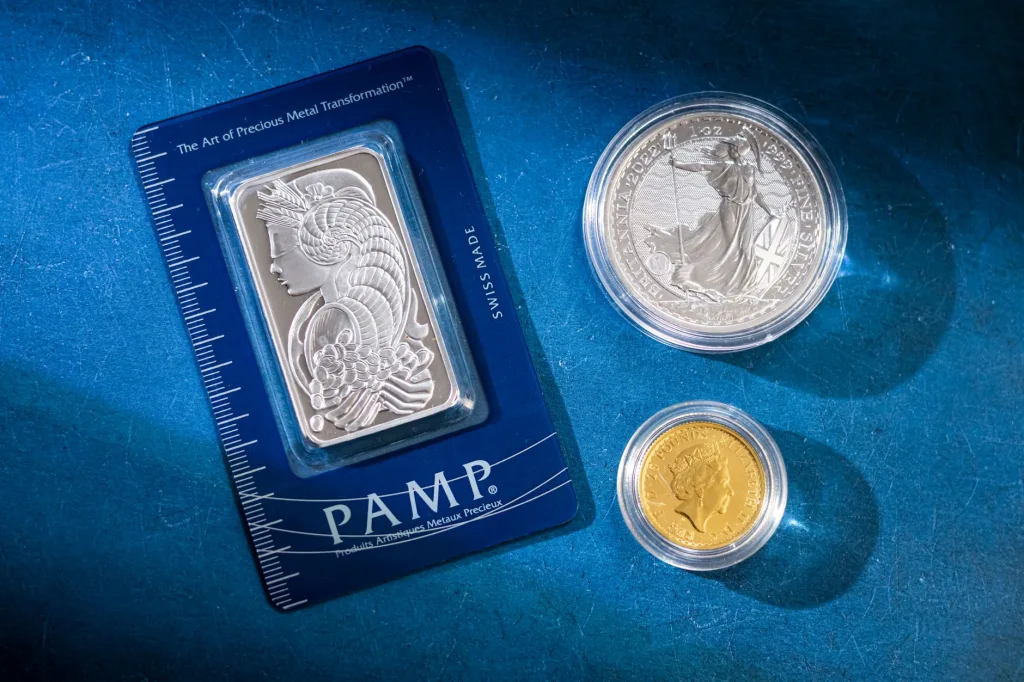
It is one of the most common questions asked over a precious metals counter: if investment gold is VAT-exempt in Estonia, why does silver come with VAT attached? The question is entirely fair — both are precious metals, both are sold as coins and bars, and both are bought for broadly similar reasons. The answer has nothing to do with economics and everything to do with tax law: in the late 1990s the European Union carved out a VAT exemption for gold, and silver was deliberately left outside it. Here is what the law actually says, and what it means for a buyer in Estonia.
The short answer
The Estonian VAT Act exempts investment gold — and only gold. Silver, platinum and palladium fall outside that exemption, which makes the sale of silver coins and bars an ordinary taxable supply. Since 1 July 2025, Estonia’s standard VAT rate has been 24% (up from 22%), and that is exactly the rate that applies to investment silver.
What counts as “investment gold” in law
Section 2(10) of the Estonian VAT Act defines investment gold very precisely. Under that definition, investment gold is:
- a gold bar or wafer of a weight accepted by the bullion markets, with a fineness of at least 995 thousandths;
- a gold coin minted after 1800, which is or has been legal tender, with a fineness of at least 900 thousandths, and whose selling price does not exceed the open market value of the gold it contains by more than 80%.
Anything meeting those conditions is exempt supply under § 16(2)(8) of the VAT Act. The word “silver” simply does not appear in that definition — and a tax exemption is a narrow carve-out that is not extended by analogy.
In practice this means a 1 oz Austrian Philharmonic gold coin is sold with no VAT at all, while a 1 oz Austrian Philharmonic silver coin of exactly the same weight is a taxed good.
Why gold got the exemption and silver did not
The carve-out is not an Estonian invention; it comes from EU law. Council Directive 98/80/EC of 12 October 1998 supplemented the common VAT system with a special scheme for investment gold. In the directive’s own words, the aim was to promote the use of gold as a financial instrument — in other words, to treat gold for tax purposes more like a savings and investment vehicle than an ordinary consumer good. The scheme has since been carried over into the VAT Directive 2006/112/EC and applies across the entire EU; the EUR-Lex summary describes it as a special scheme for gold specifically, not for precious metals in general.
The reasoning behind it was that gold already competed head-on with VAT-free financial products — deposits, bonds and fund units. Adding VAT to a gold purchase would have handed a tax advantage to every other form of saving and pushed gold trading into untaxed channels. Silver never fitted that logic, because silver is also a mainstream industrial metal: it goes into electronics, solar panels, solders, medical devices and photography. The same metal that is an investment to one buyer is a production input to another — and production inputs are taxed in the normal way.
The result is a well-known asymmetry in the bullion market: gold is bought at a “clean” price, while silver carries VAT inside the price tag.
Exactly how much VAT silver carries
The applicable standard rate is 24%. No reduced rate (13% or 9%) applies to investment silver — those are reserved for things like medicines, accommodation and printed matter. In retail, the price shown to a consumer already includes VAT, so the number on the shelf is the final amount the buyer pays.
A worked example: if the silver content plus the dealer’s margin come to 100 euros, the VAT-inclusive price is 124 euros. The same arithmetic applies to one-ounce coins such as the 1 oz American Eagle silver coin and to large bars such as the 1 kg Valcambi silver bar.
What this means for buyers in practice
Three consequences are worth understanding before comparing silver against gold:
1. There is a gap between spot and shop price at the moment of purchase. With silver, that gap has two components — the dealer’s premium (minting, shipping, handling, margin) and VAT. With gold there is only the first. That is why silver premiums always look larger in percentage terms, even though a significant slice of the difference does not go to the dealer at all, but to the state budget.
2. You do not get the VAT back when you sell. A private individual selling silver does not add VAT to the price and cannot reclaim it either. That puts silver’s break-even point — the price level at which a resale recovers the purchase cost — higher than gold’s. How much higher depends on the specific product, the prevailing bid-ask spread and the timing.
3. Larger units cut the premium, but not the tax. A kilogram bar is usually cheaper per gram than a one-ounce coin, because production and handling costs are spread over more metal. VAT, however, is a percentage and does not shrink with volume. So a 1 kg Australian Koala silver coin is better value per gram than small units, but the 24% is still there.
Are there any exceptions?
A few situations behave differently, though none of them makes silver tax-free for a private buyer:
- A VAT-registered business may deduct input VAT on goods used in its business activity under the general rules. For metal bought as an investment this is limited in practice and depends on how the goods are actually used — deducting input VAT requires a link to taxable supply.
- Reverse charge on precious metals. The VAT Act provides a reverse-charge procedure for precious metal transactions between Estonian VAT-registered persons, where the buyer accounts for the tax. It is a business-to-business mechanism, not a retail discount.
- The margin scheme. For second-hand goods, collectors’ items and antiques, the VAT Act provides a special scheme under which only the seller’s margin is taxed rather than the full selling price. Whether it applies to a particular item depends on the goods’ origin and the seller’s accounting — ask the seller directly.
Frequently asked questions
Is a silver bar treated better than a silver coin?
No. For VAT purposes bars and coins are in exactly the same position — neither falls under the investment gold definition. The difference shows up in the premium, not in the tax rate.
Is it cheaper to buy from another EU country?
The investment gold scheme is uniform across the EU, but VAT rates differ from country to country. Cross-border purchases have their own tax rules, plus shipping, insurance and resale costs. In practice the comparison has to be made on the final price, not on the headline tax rate.
Could the VAT on silver change?
The standard rate has changed in the recent past — it moved from 22% to 24% on 1 July 2025. The investment gold exemption, by contrast, is grounded in an EU directive and has been in place since it took effect in 2000.
Do I have to declare a silver purchase?
The purchase itself is not declared — VAT is already inside the price and is remitted by the seller. Taxation of any gain on a later sale is a separate, income-tax question that depends on your personal circumstances.
In summary
Silver is not tax-free in Estonia the way gold is, and that is not an oversight. EU VAT law drew the exemption deliberately and narrowly around gold in 1998, with explicit thresholds for fineness, minting year and premium. Silver fell outside it because silver is simultaneously an investment asset and an industrial raw material. For a buyer in Estonia it comes down to a single number: the silver price tag contains 24% VAT, the gold one does not. That is worth factoring in whenever you compare the costs and resale expectations of the two metals.
This article is for informational purposes only and does not constitute investment advice or a solicitation to buy or sell precious metals. Precious metal prices fluctuate. Before making any investment decision, consider your own circumstances and consult a specialist if necessary.
Goldman & Sons editorial team