Market update · 02/11/2026 · 7 min read
Precious Metals Week: Gold at a One-Year Low, Silver Below $50
Market review for the week of 26–30 October 2026.
A week in which two major central banks left rates untouched ended with precious metals at their worst levels of the year. The Fed held its target range at 3.75–4.00% on Wednesday and the ECB kept its deposit facility rate at 2.50% on Thursday — yet by Friday the gold price sat at $3,875, down 3.74% for the week and at its lowest level in more than a year. Silver fell below $50 an ounce for the first time this year. The decisions themselves held no surprises; what moved the market was what traders concluded about December afterwards — and oil.
The week’s main news
- The Fed held at 3.75–4.00%, but two members voted for a hike. Wednesday’s decision came by a 10-2 vote — and the dissents were on the hawkish side rather than the dovish one, which matters for tone. Gold held steady after the announcement; silver fell. The market is no longer arguing about the October pause but about December: on Thursday futures were pricing roughly a 90% probability of a December hike. For a metal that pays no interest, that expectation is the headwind, not the current rate. Kitco PM Report, 28 Oct 2026 · Kitco, 29 Oct 2026
- The ECB left rates unchanged but called the energy shock bigger and longer-lasting than previously assumed. Thursday left the deposit facility rate at 2.50%, the main refinancing rate at 2.65% and the marginal lending rate at 2.90%. The statement says rising energy prices have proved larger and more persistent than expected, pushing inflation up and weighing on growth, while underlying inflation has held broadly steady and wage pressure has not yet followed. At the press conference, Christine Lagarde said a hike was discussed but the Governing Council unanimously chose to wait for more data. The latest published euro-area inflation reading is September’s 3.8% (Eurostat, 16 Oct 2026). ECB monetary policy decisions, 29 Oct 2026 · ECB press conference, 29 Oct 2026 · Eurostat, 16 Oct 2026
- Gold closed the week at $3,875 — its lowest since 6 October 2025. The week opened at $3,994.95 on Sunday evening, peaked at $4,082.50 on Wednesday before the equity close, and bottomed at $3,870.25 on Friday. The last trade was $3,875.05: down 3.62% on the day and 3.74% on the week. The previous time gold traded this low was 6 October 2025. Some perspective: gold now sits roughly 13.5% below its 200-day moving average, which is around $4,490. Kitco, 30 Oct 2026 · Kitco, 30 Oct 2026
- Silver lost nearly 9% on the week and slipped below $50 — its worst week since early June. On Friday silver traded at $48.95, down close to 6% on the day. That morning it had still been at $50.08, with gold at $3,958.80, so most of the drop came in the second half of the session. Kitco ties Friday’s slide primarily to the tech-led equity selloff and the liquidation pressure it created: when a portfolio needs to raise cash, even positions that should not fall on fundamentals get sold. Silver typically feels this more sharply than gold, because the silver market is smaller and industrial demand ties it to the economic cycle. Kitco PM Report, 30 Oct 2026
- Oil remains the backdrop: attacks on shipping in the Strait of Hormuz kept Brent near $117. On Friday morning December Brent traded at $117.15 and WTI at $103.79. The logic is the same as in recent weeks: costlier energy lifts inflation expectations, higher inflation expectations keep a rate hike on the table, and a higher real rate works against gold. Blue Line Futures strategist Philip Streible put it bluntly — right now oil is the inflation the market is pricing. Geopolitical tension, which would normally support gold, is working the other way through this channel. Kitco AM Report, 30 Oct 2026 · Kitco, 30 Oct 2026
- Wall Street analysts turned decisively bearish while retail traders stayed on the bullish side. Sixteen analysts took part in Kitco’s weekly survey: one expected gains in the week ahead (6%), ten expected declines (63%) and five saw sideways action (31%). Of 184 votes in the retail poll, 53% looked for a rise, 30% for a fall and 16% for consolidation. Before the week closed, Sucden Financial forecast gold testing around $3,900 ahead of the December Fed meeting and recovering to $4,200–4,300 by mid-January. These are forecasts, not events — surveys measure sentiment, not outcomes. Kitco, 30 Oct 2026 · Kitco, 28 Oct 2026
What market commentators said
Peter Schiff posted twice on Friday. In the afternoon he wrote that gold and silver were at new lows for the year, gold below $3,940 and silver under $50 for the first time in 2026, adding that he had not expected to see those levels again (X, 30 Oct 2026). In the evening he called the day’s near-$150 fall in gold and $3-plus drop in silver ridiculous, attributing it to a short-term liquidity problem that in his view could surface in broader markets as early as the following week (X, 30 Oct 2026). Both posts end with a call to buy. That is his position, not ours, and the liquidity explanation is an interpretation that the available data can neither confirm nor refute — we include it as one reading of the week’s events, not as fact.
This week’s price and what it means for an Estonian investor
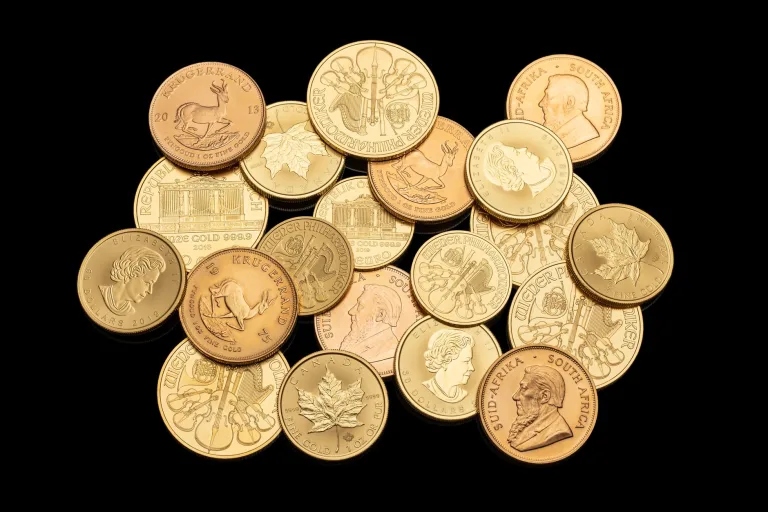
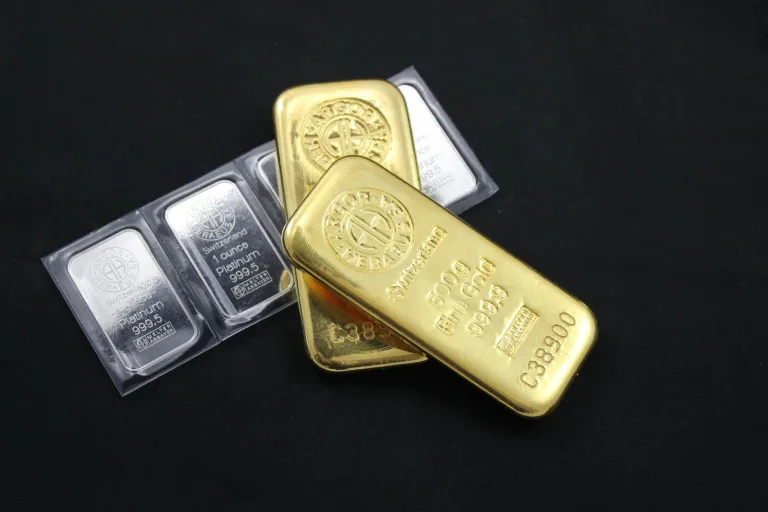
On the morning of Monday 2 November, the Estonian counter price for a one-ounce investment gold coin ran roughly €3,600–3,810: Krugerrand (earlier years) €3,616, Kangaroo €3,669, Britannia €3,678, Philharmonic €3,685, Maple Leaf €3,739, American Eagle €3,810. One-ounce gold bars sat in the same band — Valcambi €3,658, Argor-Heraeus and PAMP Suisse €3,674, PAMP Fortuna €3,724. A tenth-ounce Philharmonic cost €416. A one-ounce silver coin ran €63.12–66.22, and a kilo silver bar €1,999.
Week on week, that works out to a uniform decline of about 2.3% on one-ounce gold coins, close to €85 per coin: the Philharmonic from €3,770 to €3,685, the Maple Leaf from €3,826 to €3,739, the Krugerrand from €3,699 to €3,616. The dollar market fell 3.74%, so a euro buyer again got off more lightly — but this time not because of the exchange rate: the ECB reference rate moved from $1.1193 on 23 October to $1.1172 on 30 October, a euro just 0.2% weaker. The difference comes mainly from the timing of the snapshots — we compare counter prices Monday morning to Monday morning, and spot prices Friday close to Friday close. The silver price fell nearly 6% at the counter: a one-ounce coin dropped from the €67.08–70.18 band to €63.12–66.22, exactly €3.96 across every series. The gold/silver ratio rose from 74.1 to 79.2 — silver lost ground to gold for a third straight week, and this time by a clearly wider margin.
What follows from that in practice? First: over three weeks the counter price of a one-ounce gold coin has fallen by about €210, several times the premium gap between different coin series. Anyone choosing a series on price will notice that the Britannia and the Philharmonic are €7 apart while the week’s move was €85 — timing currently outweighs the name on the coin. Second: silver is more volatile in both directions, and in Estonia silver carries 24% VAT while investment gold coins and bars are VAT-exempt. That tax gap is permanent and independent of price moves, so silver’s decline does not narrow it — it only changes the entry price. A one-ounce Philharmonic silver coin now costs four euros less than a week ago, and a kilo Valcambi silver bar about €125 less. Third: anyone buying a fixed amount on a regular schedule gets more grams per euro in November than in October — that is the entire mechanism behind regular buying, and it works precisely in weeks like the one just past.
What to watch next
The week ahead is packed with data. The US midterm elections fall on Tuesday, which several analysts surveyed by Kitco named as the week’s biggest source of uncertainty alongside the labour-market figures. Monday brings the ISM manufacturing index, Tuesday the JOLTS job openings, Wednesday the ADP private payrolls and the ISM services index, Thursday the Bank of England decision and initial jobless claims, and Friday morning the October US employment report. The expectation is straightforward: every figure that confirms a December hike keeps pressure on metals, and every figure that undermines it takes pressure off. The second thing to watch is still oil — as long as Brent holds above $110, inflation expectations stay elevated. The third is the exchange rate: at $1.117 a weak euro has cushioned counter prices in recent weeks, and if that turns it will hit a euro investor as hard as a move in the metal itself.
This article is for informational purposes only and does not constitute investment advice or a solicitation to buy or sell precious metals. Precious metal prices fluctuate. Before making any investment decision, consider your own circumstances and consult a specialist if necessary.
Goldman & Sons editorial team