Market update · 05/10/2026 · 5 min read
Precious Metals Weekly: A Weak Euro Cancelled Gold’s Drop
Market review for the week of 28 September – 2 October 2026.
The dollar price fell. The shop price did not. Gold lost 3.4% on the week and closed Friday at $4,140.06, yet the price of a one-ounce gold coin in an Estonian shop finished almost exactly where it had been seven days earlier. The difference was currency: the euro sank to a 17-month low and, for a euro-based buyer, cancelled out the entire dollar decline. Two other stories are worth your attention — the supply picture for silver has turned, and the World Gold Council published a look at how much gold pension funds actually hold.
The week’s main headlines
- Gold closed the week 3.4% lower at $4,140.06. Friday saw gold slip 0.9%, silver 0.8% to $60.36, platinum 2% to $1,692.90 and palladium 0.5% to $1,165.75. The pressure came from two directions at once: a strengthening dollar and high bond yields, which raise the cost of holding an asset that pays no interest. That makes three consecutive down weeks. Kitco, 02.10.2026
- The US 10-year Treasury yield touched 5.34% — its highest since April 2002. On Thursday the 10-year hit 5.34% intraday and settled at 5.272%, with the 2-year at 4.814%. Over the third quarter, the 10-year posted its largest quarterly rise of this century. High long-term yields are gold’s most direct competitor: a bond pays interest, a coin does not. Kitco, 01.10.2026
- The euro fell below $1.13 for the first time since May 2025. Thursday saw the euro trade at $1.1238, down 0.79% and a 17-month low. Steven Major, global macro advisor at Tradition, pinned the move on European vulnerability: “Europe imports energy and is vulnerable to higher rates, even another eurozone financial crisis.” For a euro-based investor this is the most consequential number of the week — more on that below. Kitco, 01.10.2026
- US payrolls added just 29,000 jobs in September, and the odds of an October Fed hike collapsed from 70% to 22%. Economists had expected 90,000. Unemployment rose to 4.2%, and July and August figures were revised down by a combined 60,000 jobs. Gold rallied more than 1% on the news, then gave it all back by the close. Edward Meir of Marex warned that “the charts still look fairly grim” should the rate cycle resume its climb. A weak labour market eases rate pressure while high yields restore it — this week, the second force won. Kitco, 02.10.2026
- Deutsche Bank reckons the silver market has tipped into oversupply. Daniel Ghali, the bank’s head of metals research, said free-floating London silver inventories have risen to their highest level since November 2024 — a year ago, physical availability was at its tightest. The cause is demand destruction at high prices: Chinese industrial demand for silver in solar applications is down roughly a third year on year. His read on gold was the opposite: positioning is “probably the most bearish since October 2021,” yet official sector buying is running at more than double its 2021 pace. Kitco, 02.10.2026
- US–Iran peace talks stalled, keeping oil elevated. Negotiations to end the seven-month conflict ran aground, which held Brent at $101.23 and WTI at $90.70 a barrel. Expensive oil cuts both ways for gold: it keeps inflation expectations alive, while also feeding the very bond yields that weigh on the metal. Kitco, 02.10.2026
- The World Gold Council published case studies on how much gold pension funds hold. Across four funds, allocations sit between 2% and 5%: the Netherlands’ Pensioenfonds PDN (€7.7bn in assets) holds 5%, Fairfax County Retirement Systems in the US ($6.2bn) holds 3%, the UK’s Now Pensions 2% and Australia’s NGS Super 3%. The reasoning is similar everywhere — equity-bond correlation has risen, so traditional diversification works less well than it used to. PDN’s own analysis pointed to “lower expected portfolio risk without a reduction in expected return.” World Gold Council, 01.10.2026
This week’s price and what it means for an Estonian investor
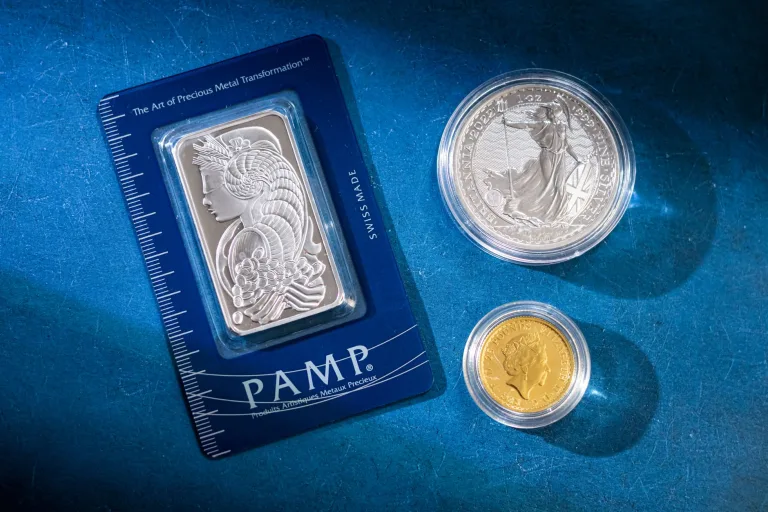
On the morning of Monday 5 October, the Estonian counter price for a one-ounce investment gold coin sat in the €3,800–3,900 range: Krugerrand (earlier years) €3,817, Kangaroo €3,841, Britannia €3,850, Philharmonic €3,858, Maple Leaf €3,915. One-ounce gold bars were in the same band — Valcambi €3,830, Argor-Heraeus €3,846. The smallest common unit, a 1/10 oz Philharmonic, cost €436. A one-ounce silver coin ran €74.90–78.00.
First, and most importantly: a euro-based investor barely saw this decline. The counter price of a one-ounce Philharmonic was €3,839 a week ago and €3,858 now — roughly a 0.5% rise, while gold’s dollar price fell 3.4%. The entire gap comes from euro weakness: when the euro drops to a 17-month low, a dollar decline disappears into the exchange rate for a euro buyer. Last week the same mechanism ran in reverse, and the euro investor’s loss was steeper than the dollar holder’s. If you buy in euros, you are always holding two prices at once: the metal’s and the currency’s.
Second, the gold-silver ratio has widened. At Friday’s closing prices — gold $4,140.06 and silver $60.36 — one ounce of gold buys roughly 68.6 ounces of silver, against about 66 a week earlier. Deutsche Bank’s oversupply call and the widening ratio tell the same story: silver moved weaker than gold this week. Three weeks is not a trend, but it is worth remembering that silver’s price is driven by industry as well as investment demand — and industrial demand answers to the economic cycle, not to geopolitics.
Third, the tax gap. Investment gold — a Philharmonic gold coin, a Britannia gold coin or an Argor-Heraeus gold bar, for instance — is VAT-exempt in Estonia. A one-ounce silver coin carries 24% VAT, which means silver’s price has to rise considerably further after purchase before the investor is back to break-even. The 2–5% pension fund allocations the WGC described were implemented through futures and funds, where that tax question never arises. For someone buying physical metal in Estonia, it does.
What to watch next
Three loose ends. First, the Fed’s October decision: the market puts the odds of a hike at 22%, down from 70% at the start of the week — a swing that large in seven days means every incoming data point will move gold too. Second, the bond market: if the 10-year yield holds near 5.3%, the pressure on gold stays regardless of what the Fed does. Third, the euro — at $1.1238, a euro investor’s position looks materially different from a dollar investor’s, and a reversal in the exchange rate would hit the counter price as hard as a move in the metal itself. Han Tan of Bybit summed up the mood: “Gold bugs are perhaps refusing to get carried away for the time being, knowing that the Fed retains a hawkish bias.”
This article is for informational purposes only and does not constitute investment advice or a solicitation to buy or sell precious metals. Precious metal prices fluctuate. Before making any investment decision, consider your own circumstances and consult a specialist if necessary.
Goldman & Sons editorial team