Market update · 12/10/2026 · 6 min read
Precious Metals Weekly: Silver at $60, Gold Claws Back
Market review for the week of 5–9 October 2026.
A week that ran in both directions. On Wednesday, gold slid below $4,100 after the Fed minutes; by Friday it was back near $4,194 and finished the week in the black. Silver reached the $60 mark. In Estonian counter prices that meant roughly a 1.3% rise for a one-ounce gold coin — and for the first time in several weeks, the dollar price and the euro price moved the same way. In the background, the World Gold Council’s August central-bank data landed: 39 tonnes added, with China logging its 22nd consecutive month of buying.
The week’s main stories
- The Fed minutes kept a December rate hike on the table, and gold broke below $4,100 on Wednesday. The minutes showed that most Fed officials still expect one more hike this year. Gold fell 1.28% on the day to $4,109.90 and silver dropped 2.55% to $59.67. The logic is familiar to gold: a higher policy rate means holding money in a bond pays more than holding a metal that pays no interest at all. Kitco, 07.10.2026
- On Friday gold rose 1.50% to $4,194.50 and silver jumped 2.77% to $60.70. Three things lined up behind the rebound: the dollar eased early in the session, Treasury yields pulled back from the week’s extremes, and bargain hunters returned at the lower prices. The 10-year yield stood at 5.24% on Friday and the dollar index near 102.10. Gold ended the week at $4,187.30, more than 1% above the previous Friday — and the entire gain came in the final two trading sessions. Kitco, 09.10.2026
- Central banks bought 39 tonnes of gold in August, bringing the year-to-date total to roughly 170 tonnes. The largest buyers were China, Uzbekistan and Poland. China added 20 tonnes in August, its 22nd straight month of purchases. Poland leads the year at 98 tonnes. Russia was a net seller in August (−6 tonnes), while Turkey returned to buying after three months of sales. Official-sector buying is the slowest and least price-sensitive part of gold demand: it does not disappear because the price fell three percent in a week. Kitco / World Gold Council data, 06.10.2026
- The dollar index broke above its June high while the euro held around $1.12. The European Central Bank’s reference rate was 1.1206 dollars per euro on 9 October, against 1.1269 on 6 October — the euro weakened slightly over the week. The dollar index broke above its June peak of about 101.75; LPL Financial’s Adam Turnquist flagged 102.86 as the next level. A strong dollar makes gold more expensive for every buyer outside the United States — and it also keeps the euro-denominated counter price elevated even when the dollar price falls. Kitco, 09.10.2026 · ECB reference rates
- Gold ETFs kept buying through the decline, while consumer sentiment hit a long-term low. Saxo Bank’s Ole Hansen pointed to “several weeks of ETF buying” — money kept flowing into gold funds even as the price fell. At the same time, the University of Michigan’s preliminary October consumer sentiment reading dropped to 46.3 from 48.1 in September, while year-ahead inflation expectations rose to 4.7% and long-run expectations to 3.5%. A weak consumer alongside rising inflation expectations is precisely the combination that leaves a central bank without an easy answer. Kitco, 09.10.2026
Comment of the week: Peter Schiff on the bond auction
In a Kitco video interview on 8 October, Peter Schiff argued that rising bond yields are good news for gold, not bad: “It’s the most bullish thing that could happen to gold and silver.” His reasoning is that as bond prices fall, some bondholders will exit their positions and look for an alternative. The facts he cited are checkable: the 10-year yield touched 5.35% on Wednesday, its highest since 2002, and the Treasury sold $39 billion of 10-year notes at a 5.3% yield, with primary dealers taking just 2.5% of the issue against a typical 9.4%. Schiff also said he holds more of his own money in mining equities than in physical bullion.
That is one market participant’s interpretation, not a forecast we endorse — the weak auction demand is a fact; what it means for the gold price is an opinion. The other side of the argument came the same week from FXTM’s Lukman Otunuga: markets are not pricing a hike in October but are pricing one for December, and over the medium term the advantage sits with the sellers.
This week’s price and what it means for an Estonian investor
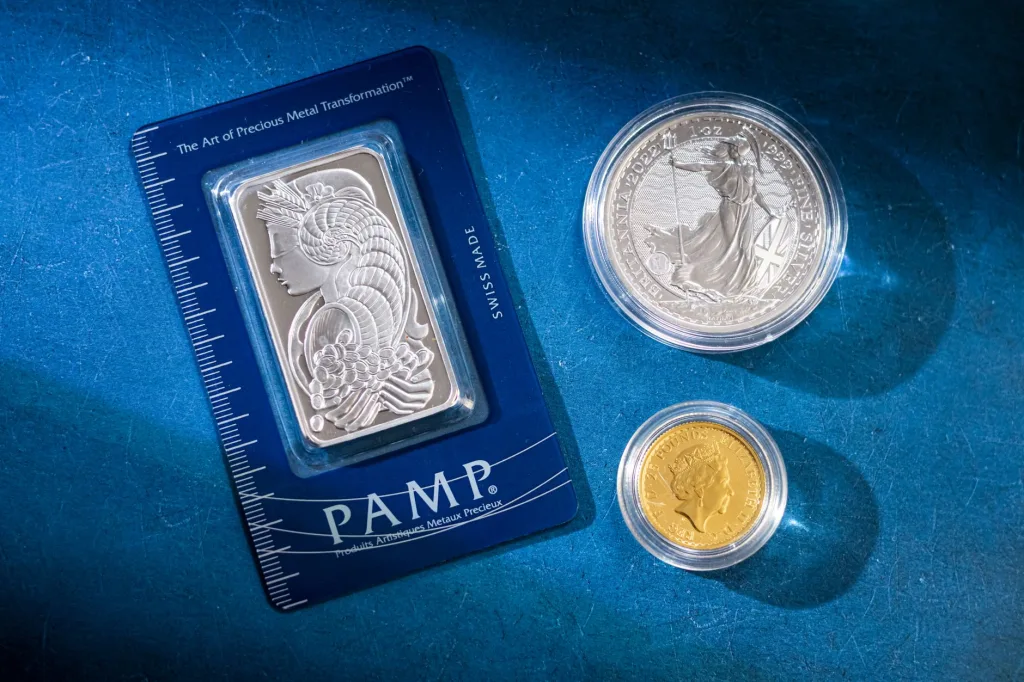
On the morning of Monday 12 October, the Estonian counter price for a one-ounce investment gold coin was roughly €3,840–3,970: Krugerrand (earlier years) €3,836, Kangaroo €3,892, Britannia €3,901, Philharmonic €3,909, Maple Leaf €3,967. One-ounce gold bars sat in the same range — Valcambi €3,881, Argor-Heraeus €3,898, PAMP Fortuna €3,950. The smallest common unit, a 1/10 oz Philharmonic, cost €442. A one-ounce silver coin ran €75.02–78.12.
First, this time both prices moved in the same direction. A one-ounce Philharmonic was €3,858 at the counter a week ago and €3,909 now — a 1.3% rise, while gold’s dollar price gained a little over one percent for the week. Britannia (+1.3%) and Maple Leaf (+1.3%) moved by exactly the same amount. The previous two weeks had the currency working against the metal: the dollar price fell while the euro price held or rose. This week the euro no longer changed the direction, it simply added a couple of tenths to the gain. Buying in euros always means two prices at once — the metal’s and the currency’s — but some weeks they are telling the same story.
Second, the size of the premium. At Friday’s price level and the ECB rate, gold’s spot price in euros was roughly €3,743 per ounce. A counter price of €3,909 therefore represents about a 4.4% premium — a typical range for a one-ounce coin, covering minting, logistics, insurance and the dealer’s margin. Smaller units are always more expensive per gram: a 1/10 oz coin at €442 works out to roughly €4,420 per ounce, a premium of over 18%. That is nobody’s mistake, just the arithmetic of production cost — minting a tenth of an ounce is not ten times cheaper than minting a full ounce. If you buy small units for flexibility, you pay for that convenience at the moment of purchase.
Third, the gap in silver. Silver’s spot price in euros was around €54 per ounce on Friday, while the counter price for a one-ounce silver coin was €75.02. Most of that gap is not premium but tax: investment gold — such as a Philharmonic gold coin, a Britannia gold coin or an Argor-Heraeus gold bar — is VAT-exempt in Estonia, whereas silver carries 24% VAT. Strip out the tax and the silver coin’s premium is roughly 12%, which is normal for a one-ounce silver piece. The practical conclusion is the same as always: after you buy, silver’s price has to rise considerably more than gold’s before a sale breaks even. The gold-silver ratio stood at 69.1 on Friday, against 68.6 a week earlier — silver lagged gold slightly over the week, even though it was the day’s winner on Friday.
What to watch next
The calendar is busy and three items on it move gold directly. Wednesday brings the U.S. consumer price index — Otunuga called it the week’s main risk, because the inflation number is what decides whether a December hike stays on the table. Thursday adds the producer price index, retail sales and jobless claims, plus remarks by Fed Chair Kevin Warsh at an IMF event. Technically, $4,200 is the level analysts say gold needs to hold above before buyers come back; below it, support sits at $4,100 and then $4,000, while on the upside the 100-day moving average sits around $4,260. A euro-based investor should also keep an eye on the currency: at $1.12, euro weakness is currently the force holding the counter price up, and a reversal in the rate would hit the price just as hard as a move in the metal itself.
This article is for informational purposes only and does not constitute investment advice or a solicitation to buy or sell precious metals. Precious metal prices fluctuate. Before making any investment decision, consider your own circumstances and consult a specialist if necessary.
Goldman & Sons editorial team